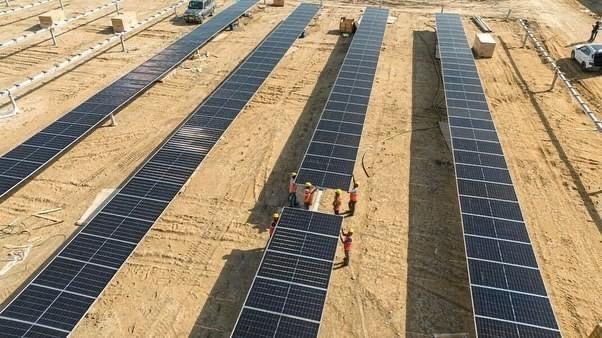
Wind blows at night. Sun shines during the day. Put them together on the same piece of land, share a single grid evacuation line, and you get power nearly 24 hours a day — at a lower cost than either technology alone. That's what hybrid EPC is all about.
We engineer and build co-located wind turbine generators (2.1 MW to 4.2 MW) and ground-mount solar arrays with a shared pooling substation — boosting plant Capacity Utilization Factor (CUF) up to 42–48%.
Single-contract accountability for wind turbine erection, solar PV micro-siting, and 132kV pooling substations.
Heavy RCC foundation concreting, tubular steel tower section erection, nacelle lifting with high-tonnage cranes, rotor blade assembly, and yaw/pitch system commissioning for 2.1 MW to 4.2 MW wind turbines.
Ground-mount TOPCon solar arrays installed between wind turbine corridors with precise shadow-clearance spacing, maximizing land utilization without compromising solar generation efficiency.
High-speed PPC managing combined wind and solar output in real-time — active ramp rate control, reactive power compensation, and frequency response compliant with IEGC Grid Code.
Single common 33kV / 66kV / 132kV pooling substation and EHV transmission line serving both wind and solar plants — cutting grid evacuation CAPEX by 25–30%.
12-month anemometer mast wind data analysis, Weibull distribution modeling, and CFD micro-siting optimization across wind corridors in Gujarat and Rajasthan.
Day-ahead and intra-day generation forecasting per CERC DSM regulations, paired with IEC 60870-5-104 real-time telemetry to the State Load Dispatch Centre (SLDC).
Wind mast data analysis, solar GHI mapping, land topography survey, and combined energy yield simulation to determine the optimal wind-to-solar capacity ratio.
WTG micro-siting, inter-row solar array layout, shared cable trenching design, PSS single-line diagram, and PPC architecture specification.
WTG foundations and solar pile driving happen simultaneously. Tower erection runs while solar module mounting is in progress. Substation construction starts early to avoid being on the critical path.
PPC commissioning, combined plant testing under all operating conditions, protection relay coordination, CEIG approval, SLDC registration, and final grid synchronization.
Combined generation metrics, wind turbine parameters, and shared grid evacuation standards.
| Technical Parameter | Engineering Specification | Applicable Standard |
|---|---|---|
| WTG Capacity Rating | 2.1 MW to 4.2 MW per Turbine (Geared / DFIG / Direct Drive) | IEC 61400-1 Class I/II/III |
| Solar PV Array Layout | Inter-Row Ground PV Arrays with Shadow-Clearance Spacing | Bifacial TOPCon Compatible |
| Capacity Utilization (CUF) | 42% to 48%+ Combined Annual CUF (Round-The-Clock Profile) | CERC / MNRE Hybrid Policy |
| Hybrid Power Controller | High-Speed PPC with Real-Time Wind/Solar Ramp Rate Control | IEC 61400-25 Telemetry |
| Shared Evacuation PSS | Common 33kV / 66kV / 132kV Pooling Switchyard & Transformer | CEA / STU Grid Code |
| Grid Code Compliance | Low Voltage Ride Through (LVRT), Fast Reactive Power Response | IEGC / CERC Compliant |
| Forecasting & Scheduling | Integrated Wind-Solar Day-Ahead & Intra-Day Forecasting Feed | SLDC Open Access Standards |
Single-contract accountability for wind, solar, and grid substation engineering.
No finger-pointing between wind and solar sub-contractors. We manage WTG erection, solar array layout, and PPC integration under one turnkey EPC contract.
The shared pooling substation is the heart of a hybrid plant. We build it in-house — from power transformer foundation to protection relay panels.
We've executed projects across Kutch, Jaisalmer, and high-wind corridors. We know ground logistics, soil conditions, and state load dispatch scheduling.
Our PPC commissioning guarantees compliance with ramp rate limits, reactive power compensation, LVRT testing, and forecasting accuracy.
Share your wind mast data and land details. Our team will run a preliminary hybrid feasibility study with estimated CUF, energy yield, and project cost.